

Introduction
Every entrepreneur has heard the same story: raise funding, hire big, spend fast, and hope the revenue catches up. For decades, this was the default playbook. But a growing wave of founders is flipping that script entirely.
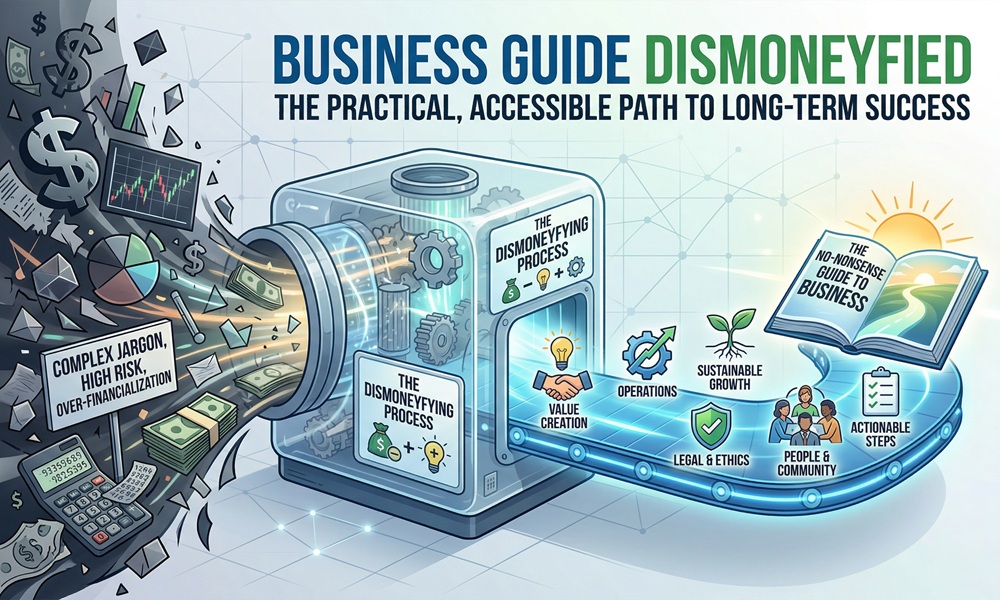
Enter the Business Guide Dismoneyfied — a modern approach to building a business that puts strategy, simplicity, and substance ahead of capital and complexity. The word “dismoneyfied” means removing money as the main measure of success. It is a mindset that values creativity, purpose, and smart use of resources instead of relying on large funding.
This is not a guide about being broke or anti-ambition. It is about building smarter — using what you have, serving real needs, and scaling through clarity rather than cash. Whether you are a freelancer, a solopreneur, or a founder tired of over-complicated advice, this guide gives you the practical framework to get there.
What Does “Dismoneyfied” Actually Mean?
The term is unconventional by design. Critics point out that “Dismoneyfied” is not a standard term found in academic business books or financial journals — and they are right. It was never meant to be. The concept borrows from well-established principles like lean startup methodology and bootstrapping, but reframes them around a core philosophical shift: stop treating money as the prerequisite for progress.
The dismoneyfied approach doesn’t advocate for ignoring money or financial metrics. Instead, it encourages business leaders to view money as a tool rather than the ultimate goal.
Going dismoneyfied means stripping business down to what actually matters — clarity, value, customers, and sustainable action. It is about removing noise, simplifying decisions, and focusing on fundamentals that drive real results instead of chasing every new trend.
Why the Traditional Approach Is Failing Founders
The modern business education industry has become a playground for profit-driven gurus who package basic concepts in expensive wrapping paper. From $5,000 masterclasses to $50,000 coaching programs, the message is clear: success costs money. This monetized approach has created a dangerous myth that effective business strategies are somehow locked behind paywalls, accessible only to those willing to invest thousands of dollars.
This myth creates three damaging outcomes:
- Capital dependency — founders wait for funding instead of building
- Decision paralysis — too much conflicting advice, not enough execution
- Burnout — chasing metrics that don’t align with actual goals
Business education has exploded over the past decade. Podcasts, courses, social media threads, and online gurus offer nonstop advice. While access to information is a good thing, it has created an unintended side effect: decision paralysis.
The dismoneyfied approach is the antidote.
The 4 Core Principles of a Dismoneyfied Business
The Business Guide Dismoneyfied framework is built on four foundational pillars:
| Principle | What It Means | Why It Matters |
|---|---|---|
| Value Over Capital | Focus on delivering results, not raising funds | Builds customer trust faster than spending |
| Simplicity & Sustainability | Build processes that are easy to manage and scale | Reduces burnout and operational drag |
| Smart Resource Management | Use tools, people, and time efficiently | Extends runway without external debt |
| Purpose Before Profit | Stay focused on long-term impact, not quick returns | Creates loyal customers, not just transactions |
These four pillars are not theory. They are operational commitments. Every decision — hiring, pricing, marketing — should filter through at least one of them.
How to Build a Dismoneyfied Business: Step-by-Step
Step 1: Conduct Lean Market Research
Skip expensive research firms. Research the problem thoroughly — not through expensive market research firms, but through direct conversations with potential customers. Spend time in forums, social media groups, and community spaces where your ideal customers gather. Listen more than you speak, and document the pain points you discover.
Your goal here is simple: find a specific problem that causes real frustration for a specific group of people.
Step 2: Build the Simplest Version of Your Solution
The dismoneyfied approach relies heavily on the MVP — a version of your product that has just enough features to satisfy early customers and provide feedback for future development. By starting small, you avoid the financial ruin that comes with building a “perfect” product that nobody actually wants to buy.
Resist the urge to add features, polish the brand, or wait until everything feels “ready.” Ship something real. Get feedback. Iterate.
Step 3: Generate Revenue Before You Scale
To keep the business dismoneyfied — independent of external debt — you need cash coming in quickly. Strategies include pre-sales (selling the product before it is fully finished to fund the final production), service-based models (offering consulting or services related to your product to generate immediate cash), and subscriptions (creating a recurring revenue model that provides a predictable monthly income).
Step 4: Leverage Your Existing Assets
The biggest barrier to business growth isn’t lack of resources — it’s the belief that you need more resources before you can begin. Inventory your existing assets: skills, relationships, knowledge, and time. Most successful businesses start with asymmetric advantages that aren’t immediately obvious.
Start with your immediate network. Your first 10 customers are closer than you think.
Step 5: Automate and Outsource Strategically
Audit your current expenses ruthlessly. Eliminate subscriptions to tools and services that don’t directly contribute to customer value or operational efficiency. Many businesses operate with bloated technology stacks and unnecessary overhead costs that drain resources without providing proportional returns.
Automate repetitive tasks using free or low-cost tools and outsource work that doesn’t require your specific expertise.
Step 6: Build a Community, Not Just a Customer Base
A loyal community is the ultimate dismoneyfied asset. By engaging with customers on social media and addressing their feedback, you turn users into advocates. Word-of-mouth marketing is free, and in this model, it is your most powerful growth tool.
Dismoneyfied vs. Traditional Business: A Direct Comparison
| Factor | Traditional Model | Dismoneyfied Model |
|---|---|---|
| Starting capital | High (loans, investors) | Low (self-funded, pre-sales) |
| Growth driver | Spending & advertising | Value creation & word-of-mouth |
| Risk level | High (debt exposure) | Low (lean operations) |
| Speed to market | Slow (over-planning) | Fast (MVP-first) |
| Focus | Revenue targets | Problem-solving & customer value |
| Flexibility | Rigid (stakeholder pressure) | High (adapt quickly) |
| Sustainability | Dependent on funding rounds | Built on consistent cash flow |
This table is not about dismissing traditional business. Large-scale ventures often need external capital. But for the vast majority of founders — especially those building service businesses, content brands, or digital products — the dismoneyfied model is not only viable, it is often superior.
Key Advantages of Going Dismoneyfied
The dismoneyfied approach offers several advantages:
Low Financial Risk — You don’t need large loans or investors. This also means you keep equity and control.
Greater Flexibility — Work from anywhere and adjust fast. When market conditions shift, lean businesses pivot with minimal friction.
Open to Everyone — Anyone with skill and focus can begin. The barrier is not money — it is clarity and commitment.
Compound Learning — The dismoneyfied framework teaches leaders to invest strategically in areas that compound over time, even when the immediate financial returns aren’t apparent.
Common Mistakes to Avoid
Even within a lean model, founders make predictable errors. Here are the most critical ones to watch for:
- Confusing frugality with strategy — Cutting all expenses equally during hard times is not resourcefulness; it is panic. Many struggling businesses make the mistake of treating all expenses equally, cutting budgets across the board when facing financial pressure.
- Over-relying on the “dismoneyfied” label — The concept is only valuable if applied with discipline. It is not a magic word that replaces execution.
- Avoiding tools entirely — Automation and tools are useful, but only when they reduce work. If a system requires constant maintenance or causes confusion, it is not helping.
- Chasing complexity — Many businesses fail because they try to do too much. A dismoneyfied business focuses on solving a specific problem for a specific group of people. Clarity beats variety.
- Ignoring the safety check — If you encounter a version of this guide that promises instant wealth with zero effort, be extremely cautious. Real business growth — especially the lean, self-sustaining kind — requires significant hard work, time, and dedication.
Who Is This Approach For?
The dismoneyfied model is not a one-size-fits-all prescription, but it is particularly well-suited for:
- First-time founders who want to test an idea without mortgaging their future
- Freelancers and consultants looking to productize their expertise
- Side hustlers ready to convert passion into a primary income source
- Small business owners who are over-leveraged and want to simplify operations
- Digital product creators — course builders, SaaS founders, content businesses
While especially helpful for small businesses, simplification benefits companies of all sizes. Even enterprise leaders use dismoneyfied thinking to strip internal bloat, reduce decision fatigue, and sharpen strategic focus.
Final Word: Progress Over Polish
The dismoneyfied business guide is not a shortcut — it is a recalibration. It asks you to question the assumptions that expensive advice has built into your thinking: that you need more money, more tools, more employees, and more time before you can begin.
Implementing these principles won’t eliminate financial challenges, but it will position your business to weather economic storms, attract top talent, build loyal customer bases, and achieve the kind of enduring success that transcends quarterly earnings reports. The dismoneyfied approach isn’t about ignoring money; it’s about mastering money by understanding what truly drives business value in an increasingly complex world.
Start with the problem. Serve the customer. Stay lean. Build forward.
That is the business guide dismoneyfied — in practice.
