

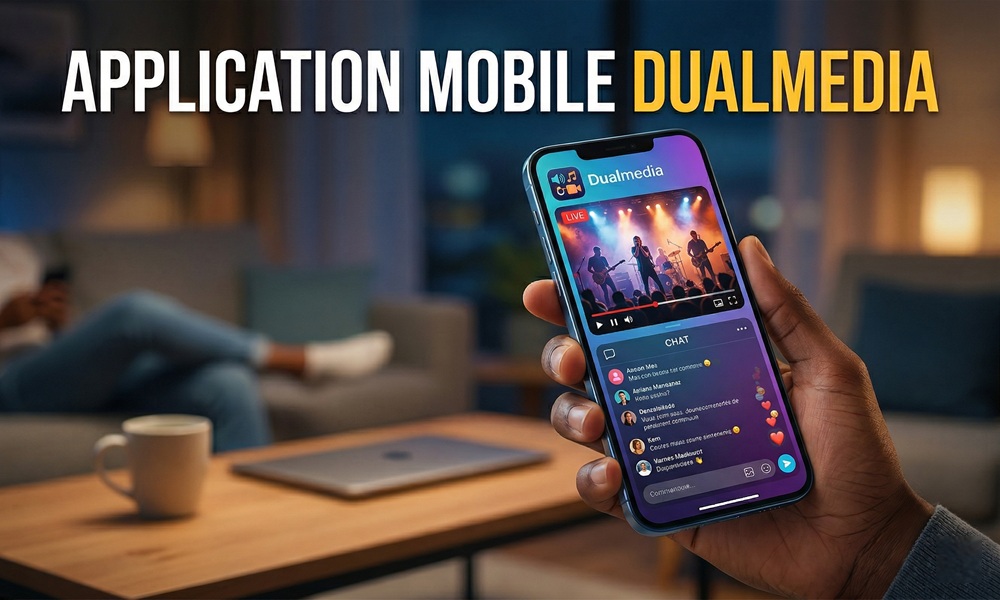
The mobile app landscape has changed dramatically in recent years. Users no longer want a single-purpose tool — they want rich, flexible, and immersive experiences that work across every device, every format, and every context. This is exactly the need that application mobile DualMedia was built to meet.
Whether you’re a business owner, a content creator, a developer, or simply a curious digital user, this guide breaks down everything you need to know — from the core concept and standout features to real-world use cases, technical architecture, and what the future holds.
What Is Application Mobile DualMedia?
An application mobile DualMedia is a type of mobile app designed to handle two or more media formats — like video, audio, and interactive content — within a single, seamless experience. In simple terms, it’s an app that brings together different forms of media and lets users interact, watch, listen, and engage across multiple platforms such as iOS, Android, and the web.
But the concept runs deeper than just “combining media.” At its core, application mobile DualMedia refers to a mobile platform that simultaneously manages and delivers multiple forms of media content. Instead of focusing on a single medium such as video or messaging, the system integrates several media channels into one unified interface.
There are also two closely related meanings of the term worth knowing:
- DualMedia as a Platform — A content creation and distribution app that lets users produce, share, and monetize both audio and video content from one place.
- DualMedia as an Agency — A Paris-based web agency established in 2000, with expertise in mobile application development on iPhone and Android, website design, and SEO optimization.
Both interpretations are covered in this guide.
The Origin and Evolution of DualMedia Apps
The idea didn’t emerge overnight. In the early days of mobile development, apps were simple — they performed a single function, like messaging, watching videos, or playing audio. But as users became more digital and multitasking grew common, developers saw the need for something more flexible. Many experts believe this change started with cross-platform app frameworks like Flutter and React Native, which made it easier to design apps that work smoothly on both Android and iOS.
Several technological advancements accelerated this shift: faster mobile networks such as 4G and 5G, more powerful smartphone processors and GPUs, cloud infrastructure for large media file delivery, and user demand for fewer apps that accomplish more tasks in a single place. These developments created the perfect environment for application mobile DualMedia to thrive.
Key Features of Application Mobile DualMedia
DualMedia is a multifunctional media platform that lets you create, view, and monetize multimedia content through one unified interface. The platform’s main advantage is its dual-format approach — your content can exist in multiple forms at the same time.
Here is a breakdown of the standout features:
| Feature | Description | Benefit |
|---|---|---|
| Dual-Format Media | Record, stream, and publish in audio and video simultaneously | No need for separate tools |
| AI-Powered Editing | Auto-edit, transcribe, caption, and enhance media in taps | Saves post-production time |
| Real-Time Sync | Audio/video syncing during live sessions | Smooth live streaming experience |
| Cross-Platform Support | Works on iOS, Android, and web | Broader audience reach |
| Cloud Infrastructure | Removes traditional production limits | Scalable, flexible creation |
| Content Monetization | In-app tools for sponsorships and revenue | Helps creators earn directly |
| End-to-End Encryption | Secure all data and uploads | Privacy-first user experience |
| Offline Access | Available without internet connection | Great for on-the-go users |
| Customizable Dashboard | Personalized UI for creators | Better workflow management |
| AI Recommendations | Content suggestions based on user habits | Keeps users engaged longer |
The standout appeal of Application Mobile DualMedia lies in its feature-rich ecosystem. It typically offers multimedia playback, content sharing, and cloud-based synchronization. Users can also enjoy customizable dashboards, offline access, and cross-device compatibility. Together, these features create a unified platform that supports different aspects of daily life.
How the DualMedia App Works: The Architecture
Understanding what powers these apps helps you appreciate their value. A well-built DualMedia application is structured in layers.
The Four Core Layers
1. Content Layer This handles videos, audio files, AR/VR elements, blogs, and all digital media. It’s the foundation of what users consume.
2. Interactive Layer Live chat, polls, Q&A sessions, and in-app communication tools. This makes users feel more connected and transforms passive viewing into active participation.
3. Connection Layer Links media with user actions like sharing, purchasing, and engagement tracking.
4. Data Layer AI tracks and analyzes user behavior for improvements and personalization. Artificial intelligence recommends content and personalizes experiences based on shopping suggestions or learning patterns.
The Technology Stack
Cross-platform frameworks like React Native or Flutter help teams ship faster while preserving near-native performance and a consistent design system. Clean API integration, automated CI/CD pipelines, and proactive performance optimization reduce release risk and keep quality high as features scale.
Native programming languages such as Swift for iOS and Kotlin for Android are also used to optimize performance. These languages provide direct access to device hardware and system services. DualMedia applications rely heavily on network connectivity, where network stability ensures uninterrupted communication and smooth content playback.
Real-World Use Cases Across Industries
One of the strongest arguments for DualMedia apps is how broadly they apply. Here’s how various sectors are using them in 2025:
🎓 Education
Language apps pairing video dialogues with speech-recognition exercises are a prime example. Apps like Byju’s or Coursera use video learning plus interactive tests to create a richer, more engaging learning environment.
🏥 Healthcare
Therapy apps combining guided meditation audio with biometric feedback visualizations give users a more integrated wellness experience.
🛒 E-Commerce and Retail
Virtual try-on features merging AR overlays with product storytelling videos help reduce buyer hesitation and increase purchase confidence.
📰 News and Journalism
Articles embedding interactive data visualizations alongside video reports are transforming how news is consumed — making it more contextual and compelling.
🎵 Entertainment and Creator Economy
Apps like TikTok, Clubhouse, and Headspace dominate the mobile media space, but DualMedia offers something different: dual-format capabilities and hidden tools most users never find. Whether you’re an indie artist releasing content in multiple formats, a language tutor growing course signups, or a podcaster expanding into video, these features change how media gets produced and consumed.
🏋️ Fitness
Apps like Peloton use live workout streaming combined with progress analytics dashboards — a classic DualMedia approach that blends motivation with measurable results.
Why Businesses Are Investing in DualMedia Apps
The business case for DualMedia apps is backed by data, not just theory.
Combining media types caters to diverse learning styles, increasing session duration by up to 40% according to 2025 industry reports. Studies also show users remember 75% more content when it’s presented through dual sensory channels such as visual plus auditory input.
Here’s a quick comparison of traditional vs. DualMedia apps:
| Metric | Traditional Single-Medium App | DualMedia App |
|---|---|---|
| User Engagement | Moderate | Up to 40% higher |
| Content Retention | ~30% | Up to 75% |
| Creator Workflow | Multiple tools needed | Single unified platform |
| Monetization Options | Limited | In-app, sponsorships, subscriptions |
| Audience Reach | Platform-specific | Cross-platform and cross-format |
| Personalization | Basic | AI-driven, real-time |
A tech reviewer boosted his YouTube and podcast audiences by 150% within 60 days by consolidating his workflow through DualMedia. An indie artist released dual-format EPs and gained sponsorship from local brands using in-app monetization. A language tutor saw a 4x increase in course signups after delivering lessons in both audio and video formats.
DualMedia — The Paris Agency Behind the Vision
The term “application mobile DualMedia” also refers directly to the Paris-based digital agency that has been building these solutions since the early 2000s.
DualMedia, a digital agency based in the heart of Paris, specializes in web development and mobile applications, supporting companies and entrepreneurs in the realization of tailor-made digital projects. Through a blend of digital innovation and technical expertise, DualMedia offers customized web and mobile solutions tailored to the specific requirements of each customer.
What the Agency Offers
DualMedia has grown into a mobile development powerhouse in the last 15 years. Their team has created over 200 custom apps for clients of all types. They excel at building native apps for both iOS and Android that give users a smooth experience on each platform.
Their three core service pillars are:
- Application Mobile Agency — Custom iOS and Android app development
- Web Agency — Website creation and innovative web solutions
- SEO Agency — Search engine optimization and digital visibility
At the core of Agence Web Paris DualMedia’s design philosophy is user experience (UX). Every website is built with the end user in mind, ensuring intuitive navigation, fast performance, and clear content structure. DualMedia follows a mobile-first design strategy, ensuring websites perform seamlessly across smartphones, tablets, and desktops.
Proven Client Results
Client testimonials show impressive results. The company’s complete approach has boosted business reservations by 35% and brought in 40% new clients. Dualmedia offers everything from website creation to custom web development, digital marketing, SEO, web hosting, and maintenance.
How to Get Started with Application Mobile DualMedia
Getting started is straightforward, whether you’re a user or a business:
For End Users (Content Creators)
Download and install the app from your app store. Sign up with your email, social account, or phone number. Choose your creator profile — Video, Audio, or Dual. Set up your dashboard, link your social accounts, and start creating. The setup takes less than 10 minutes, and the onboarding tutorial walks you through all features intuitively.
For Businesses and Startups (Working with the Agency)
Great apps start with a clear problem statement and lean discovery: define your audience, map jobs-to-be-done, and align success metrics. Move into rapid prototyping with clickable wireframes to validate flows, then implement an MVP that focuses on the smallest set of features that deliver real value.
Treat onboarding as a product moment — not just a tutorial — so users reach first value quickly. Reinforce it with timely push notifications and ethical in-app purchases where they make sense. Establish a straightforward measurement strategy to monitor user activation, retention, and key events. Then use A/B testing to fine-tune messaging and user flows.
Challenges to Know Before You Build or Adopt
No technology is without its hurdles. Being aware of these helps you plan smarter:
Battery consumption remains a concern, as simultaneous media processing strains device resources. Developers must also navigate accessibility compliance — ensuring DualMedia experiences work for users with disabilities.
Other challenges include:
- Data privacy and GDPR compliance — especially critical for apps operating across European markets
- Network dependency — rich media apps can struggle on low-bandwidth connections
- Content moderation — managing dual-format user-generated content at scale
- Development cost — building a true DualMedia app requires cross-disciplinary expertise
The good news: these are solvable problems with the right team and the right framework.
The Future of Application Mobile DualMedia
The trajectory for DualMedia applications is strongly upward.
Future plans for DualMedia include integrating immersive 3D audio technology, advanced virtual background capabilities, blockchain-based content rights management, and a creator marketplace with AI-powered matching algorithms for collaborations and projects.
5G expansion and edge computing will mitigate latency issues, enabling richer real-time interactions. Expect AI to drive hyper-personalization, where apps predict optimal media blends before users request them. By 2027, Gartner predicts 60% of top-performing apps will incorporate DualMedia principles as standard.
Additionally, integration with wearables, spatial computing (like Apple Vision Pro), and AR/VR environments will make DualMedia apps even more immersive and contextually intelligent.
Quick Comparison: DualMedia vs. Single-Format Apps
| Criteria | Single-Format App | Application Mobile DualMedia |
|---|---|---|
| Media Types | One (video OR audio) | Multiple simultaneously |
| User Journey | Linear | Multi-layered and interactive |
| Creator Tools | Separate workflows | Unified platform |
| AI Integration | Basic | Deep, real-time personalization |
| Future-Readiness | Limited | Built for 5G, AR, and wearables |
| Monetization | Platform-dependent | Built-in, direct-to-creator |
