
Software bugs are inevitable. But how a team manages them separates a smooth, high-quality release from a costly, delayed disaster. Studies suggest that fixing bugs after a product launches can cost up to 30 times more than catching them during development. That financial reality is exactly why purpose-built platforms like EndBugFlow have become essential in modern software pipelines.
So, how does EndBugFlow software work? Whether you are a developer, QA tester, or project manager, this guide unpacks the platform from the ground up — its architecture, step-by-step workflow, integrations, and the tangible value it delivers to Agile and DevOps teams.
What Is EndBugFlow?
EndBugFlow is a specialized bug-tracking and workflow management platform built for the specific demands of software development teams. Rather than relying on scattered email threads, outdated spreadsheets, or disjointed chat messages, it provides a centralized ecosystem where every issue is logged, prioritized, assigned, tracked, and resolved with complete accountability.
What makes EndBugFlow stand out from generic project management tools is its focus on the complete bug lifecycle — from the moment an error is detected in production all the way through verification and post-closure analytics. It is particularly effective in Agile sprints and DevOps pipelines, where rapid iteration and clear cross-team communication are non-negotiable.
The Core Architecture: Three Foundational Layers
Understanding how EndBugFlow software works starts with its multi-layered technical architecture. The platform is not a single-function tool — it operates through three interconnected layers that handle detection, intelligence, and resolution.
Layer 1 — Real-Time Error Detection
EndBugFlow embeds lightweight agent SDKs directly into your codebase. These agents constantly monitor application performance at runtime, capturing stack traces, exception reports, memory usage anomalies, and API failure logs.
As soon as an error occurs in production, staging, or development, the agent transmits the full failure context to the EndBugFlow cloud dashboard. Unlike generic log aggregators, EndBugFlow also records the environmental state at the time of the bug — including operating system details, active threads, variable states, and user session data.
Layer 2 — AI-Powered Analysis Engine
EndBugFlow’s AI engine takes over once it ingests the error data. The platform uses machine learning models trained on millions of real-world bug patterns. These models automatically classify and prioritize issues, distinguishing between a new bug and a regression, and identifying whether an issue is isolated or systemic.
Layer 3 — Source Map Integration
EndBugFlow maps errors directly back to specific lines of code across multiple codebase versions. Even in minified or transpiled production builds, EndBugFlow uses source map integration to pinpoint the exact error origin in the original source code. Developers immediately see which function, file, and line caused the problem.
Key Features at a Glance
Before diving into the workflow, here is a quick reference of the platform’s core capabilities:
| Feature | What It Does |
|---|---|
| Automated Bug Capture | Logs bugs via APIs, error logs, or user forms with zero manual entry |
| Smart Task Assignment | AI recommends the best developer based on workload and expertise |
| Severity Classification | Four-tier system: Critical, High, Medium, Low |
| Real-Time Dashboard | Visual overview of all bugs, statuses, and team assignments |
| Status Pipeline | Structured lifecycle from New → In Progress → Review → Resolved |
| QA Verification Loop | Bugs return to developers automatically if verification fails |
| Analytics & Reporting | Resolution times, backlog trends, error-prone code areas |
| Third-Party Integrations | Git, Jira, Slack, Sentry, Jenkins, and more |
How EndBugFlow Works: The Step-by-Step Workflow
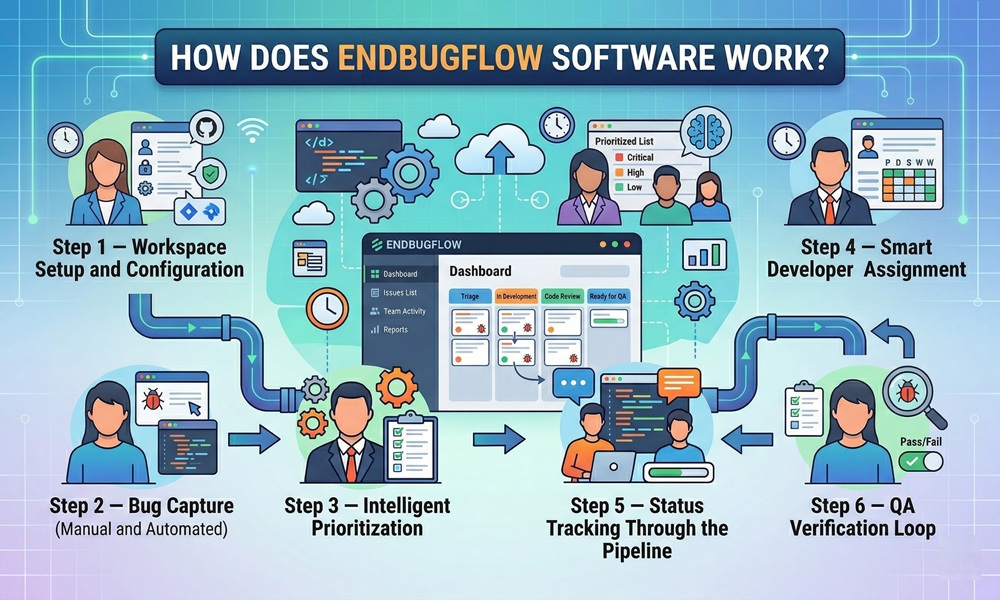
Step 1 — Workspace Setup and Configuration
Start by creating a workspace, defining team members, roles (developer, QA tester, manager), and notification preferences. Integrate with existing tools like Git for version control or CI/CD pipelines for automatic bug detection during builds. Set custom rules for prioritization, such as auto-escalating bugs affecting production environments.
This initial configuration is what allows the platform to work intelligently — every automation rule, every smart assignment, and every alert depends on how the workspace is structured from day one.
Step 2 — Bug Capture (Manual and Automated)
The platform begins by capturing bug reports from multiple sources. Whether a tester discovers an issue during quality assurance, a developer encounters an unexpected error, or an end user reports a problem, EndBugFlow creates a unified repository for all these incidents.
The software provides an intuitive interface where users can log issues with detailed information — including screenshots, screen recordings, system specifications, browser details, and step-by-step reproduction instructions.
For automated capture, EndBugFlow’s log aggregation module consolidates data streams from server logs, client-side error reports, database queries, and third-party API interactions into a single, searchable dashboard.
Step 3 — Intelligent Prioritization
Not every bug deserves the same level of urgency. EndBugFlow uses a four-tier severity classification: Critical (system crashes, data loss, security breaches), High (major features broken, significant user impact), and lower tiers for less impactful issues. The bug prioritization process considers multiple factors beyond severity — customer impact, affected module, and release timeline all influence which bugs get tackled first.
Using pattern recognition algorithms, it groups related errors together, identifies recurring issues, and ranks bugs by severity and frequency. This allows development teams to prioritize fixes strategically — addressing the most impactful bugs first rather than getting overwhelmed by a flood of isolated reports.
Step 4 — Smart Developer Assignment
EndBugFlow features “smart assignment” tools that suggest the best person for the job based on their specific expertise and current workload, preventing team burnout.
The platform improves assignment by recommending the most suitable developer based on current workload, matching bugs with developers who have the right technical expertise, considering module ownership to ensure issues go to the correct team member, and reducing workflow bottlenecks and preventing task overload.
Step 5 — Status Tracking Through the Pipeline
EndBugFlow’s status pipeline typically includes: New → Acknowledged → In Progress → Code Review → Testing → Verified → Closed. Each transition triggers appropriate notification alerts. Developers see what needs attention. QA knows what’s ready for verification. Managers track overall progress without micromanaging.
The workflow automation tools reduce manual status updates. When a developer commits code referencing a bug ID, EndBugFlow automatically moves that issue to “Code Review,” making integration with your version control system seamless.
Step 6 — QA Verification Loop
After developers fix a bug, EndBugFlow facilitates the verification process. The software notifies the original reporter and assigned testers that a fix is ready for validation. Testers can then verify the resolution in staging or testing environments before the fix reaches production. If the bug persists, testers can reopen the issue with additional details, keeping the entire history intact.
This closed-loop system is one of EndBugFlow’s most valuable safeguards — it prevents the common failure mode of marking a bug “resolved” when it is only partially fixed.
Step 7 — Analytics and Post-Resolution Reporting
Raw data becomes actionable intelligence through EndBugFlow’s analytics engine. The bug resolution analytics reveal patterns you would never spot manually, driving proactive bug prevention.
Managers gain access to insights like average resolution time, backlog growth rates, and which areas of the codebase are most error-prone — information that directly informs smarter future development decisions.
Integration Ecosystem
One of EndBugFlow’s practical strengths is how well it connects with the tools your team already uses. Rather than forcing a workflow change, it slots into your existing stack.
| Category | Supported Tools |
|---|---|
| Version Control | GitHub, GitLab — link bugs to commits and pull requests |
| Project Management | Jira, Trello, Asana — sync tasks and timelines |
| Communication | Slack, Microsoft Teams — receive real-time alerts in chat |
| CI/CD Pipelines | Jenkins, CircleCI — automate bug detection during builds |
| Error Monitoring | Sentry, LogRocket — import error logs directly |
| Enterprise Systems | Salesforce and ERP tools for enterprise-level workflows |
Automated bug reports from EndBugFlow can be automatically pushed to popular project management platforms like Jira, GitHub Issues, Trello, or Azure DevOps. For teams operating under tight release schedules, this automation ensures nothing slips through the cracks and that every detected issue is tracked.
EndBugFlow vs. Traditional Bug Tracking Methods
How does EndBugFlow compare to the methods many teams still rely on?
| Criteria | Spreadsheets / Email | EndBugFlow |
|---|---|---|
| Bug Capture | Manual entry, prone to gaps | Automated via APIs and SDKs |
| Prioritization | Subjective, inconsistent | AI-driven, four-tier severity system |
| Task Assignment | Manual, often based on guesswork | Smart suggestions based on workload & skill |
| Status Visibility | Siloed, requires chasing updates | Real-time dashboard for all stakeholders |
| QA Loop | Often skipped or informal | Structured re-verification built into workflow |
| Analytics | None or manual compilation | Built-in reporting with trend detection |
| Tool Integration | None | Native integration with Git, CI/CD, Slack, and more |
EndBugFlow automates bug capture and provides real-time collaboration features. Spreadsheets require manual updates and lack task assignment automation, making them slower for team coordination.
Who Benefits Most from EndBugFlow?
EndBugFlow is designed to serve multiple roles within a development team, and each role gets something distinct from the platform:
- Developers — Spend less time hunting for bug context and more time writing fixes. Source map integration eliminates detective work on minified production code.
- QA Testers — Get detailed, structured issue cards with reproduction steps, impacted environments, error frequency, and affected users. Verification workflows are clearly defined.
- Project Managers — Gain full visibility into bottlenecks, backlog growth, and team capacity without needing to micromanage daily stand-ups.
- DevOps Engineers — Benefit from seamless CI/CD integration that catches bugs during the build process before they ever reach users.
Considerations Before Adopting EndBugFlow
No tool is without trade-offs. Teams evaluating EndBugFlow should weigh these factors:
- Learning Curve: New users may require a short training period to master the advanced analytics features.
- Subscription Costs: For very small teams, the cost of the software is a factor to weigh against the time saved.
- Data Security: Because the platform stores sensitive bug reports and error logs, teams should evaluate the provider’s privacy and data handling policies before onboarding.
The Road Ahead: What’s Next for EndBugFlow
Looking forward, the platform is expected to evolve with AI-powered predictions that anticipate bugs before they even occur, and deeper DevOps integrations that connect directly with CI/CD pipelines. The long-term direction points toward predictive debugging — a model where the system flags high-risk code areas before a bug is ever reported by a user, transforming quality assurance from reactive to truly proactive.
