

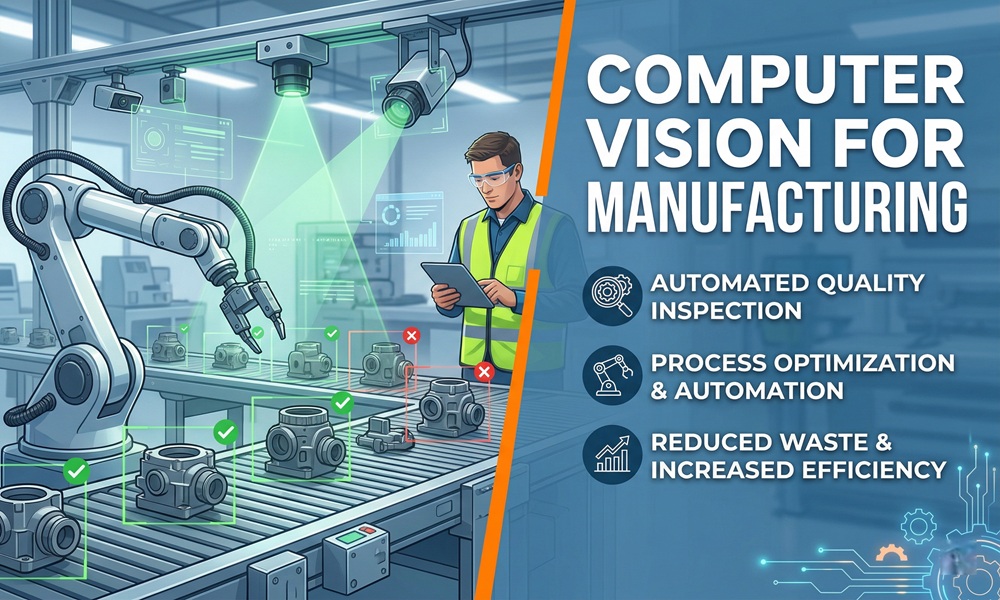
The factory floor of 2026 looks nothing like it did five years ago. Cameras watch every weld. Algorithms inspect every surface. Robots pick and place guided not by rigid pre-programmed coordinates, but by real-time visual intelligence that adapts on the fly.
Computer vision for manufacturing — the application of AI-powered imaging systems to automate inspection, guide robots, monitor equipment, and enforce safety — has crossed a decisive threshold. It is no longer experimental technology being piloted in innovation labs. According to Roboflow’s 2026 Vision AI Trends report, which analyzed over 200,000 real computer vision projects, it is now mission-critical infrastructure across manufacturing, logistics, automotive, and pharmaceuticals.
The market numbers reflect this maturity. The global computer vision market has surpassed $32.88 billion in 2026 and is projected to reach $68.38 billion by 2031, growing at a CAGR of 15.77%. The AI-in-computer-vision segment specifically is valued at $34.94 billion in 2026 and is expected to hit $254.51 billion by 2033 at a staggering 32.8% CAGR. Manufacturing leads all end-user industries with a 28.49% market share — and it is easy to see why.
This guide covers how computer vision actually works in production environments, where it delivers the highest returns in 2026, what the validated outcome data shows, and what manufacturers must account for before investing.
How Computer Vision Works in a Modern Factory
A manufacturing computer vision system does five things in sequence, usually in under 200 milliseconds:
- Capture — Industrial cameras, thermal sensors, hyperspectral imagers, or 3D depth scanners acquire visual data from the product or process.
- Preprocess — Raw frames are normalized, denoised, and formatted for inference.
- Infer — A trained deep learning model (CNN, Vision Transformer, YOLO variant) analyzes the image and outputs a classification, bounding box, segmentation mask, or anomaly score.
- Decide — The system flags a defect, stops the line via PLC signal, triggers a robot correction, or logs the result to MES/SCADA dashboards.
- Improve — The model retrains on new production data over time, closing the accuracy gap between deployment and real-world performance.
The critical distinction from legacy rule-based machine vision is adaptability. Old systems broke the moment lighting shifted or a new SKU was introduced. Modern AI-based CV generalizes across product variation, learns from production data, and sustains accuracy over the long term — which is what makes it viable for high-mix manufacturing environments.
2026 Reality Check: Roboflow’s analysis notes that off-the-shelf CV tools “stumble when confronted with the nuanced, ever-changing reality” of real factory conditions. A model achieving 98% accuracy in a vendor demo may deliver only 75% on the actual production floor. Custom development — trained on your products, your lighting, your failure modes — is what separates genuine ROI from an expensive pilot that stalls.
Core Computer Vision Techniques Used in Manufacturing
| Technique | What It Does | Primary Manufacturing Use Case |
|---|---|---|
| Image Classification | Pass/fail categorization of an image | High-speed binary quality gates |
| Object Detection | Locates specific objects within a frame | Missing fastener, misaligned label detection |
| Semantic Segmentation | Classifies every pixel in an image | Precision defect boundary mapping in semiconductors |
| Instance Segmentation | Separates individual objects of the same class | Robotic part picking, PCB component identification |
| Anomaly Detection | Flags deviations from a learned baseline | Predictive maintenance, surface defect detection |
| Pose Estimation | Tracks position and orientation of objects or people | Ergonomic monitoring, robot guidance |
| 3D Vision / Depth Sensing | Captures spatial geometry | Dimensional inspection, weld quality, digital twins |
| Thermal Imaging + CV | Detects heat patterns indicating failure | Bearing wear, electrical fault detection |
| Synthetic Data Training | Trains models on simulated images | Rare defect detection without real defect samples |
The last two are notably gaining traction in 2026. Thermal-vision fusion is becoming standard in predictive maintenance applications. Synthetic data training — recently validated in a March 2026 Springer Nature study on semiconductor wafer inspection — is solving the long-standing problem of insufficient real defect samples for training.
Key Applications and Use Cases in 2026
1. Automated Quality Control and Defect Detection
Quality inspection commands 41.08% of all computer vision application revenue in manufacturing — the single largest use case. And the performance benchmarks have reached a level that makes a compelling case on its own: AI vision systems now routinely detect defects as small as 0.1mm at full line speed, inspecting 100% of output rather than statistical samples.
Real-world outcomes documented in 2025–2026 deployments:
- Siemens integrated CV across electronics manufacturing lines, achieving 99.7% defect detection accuracy, reducing warranty claims by 40%.
- A leading smartphone manufacturer deployed vision systems to inspect for 47 defect types simultaneously, achieving 99.2% detection accuracy and cutting customer returns by 63%.
- A major steel producer using Matroid’s AI inspection system improved detection accuracy from 70% to 98%+, delivering annual savings of over $2 million and a 1,900% ROI.
- Intel achieved $2 million in annual savings through AI vision inspection, with ROI realized within 6–12 months.
- An electronics manufacturer reduced its defect escape rate from 2.3% to 0.1%, saving $1.8M annually in warranty claims.
Human inspection, by contrast, loses up to 30% accuracy due to fatigue across a long shift and peaks at 2–3 items per minute. A single AI vision station can match the throughput of 4–6 human inspectors continuously.
2. Predictive Maintenance
Unplanned manufacturing downtime costs the global industry an estimated $50 billion annually. CV-based predictive maintenance attacks this number directly.
Thermal cameras combined with high-resolution imaging monitor rotating machinery, conveyor systems, and drive components for early signatures of failure — micro-cracks, heat anomalies, surface wear, and misalignment — that precede breakdown by hours or days. Critically, these visual signals often appear before vibration sensors or oil analysis would detect a problem, providing an earlier intervention window.
Validated 2026 outcomes:
- Predictive maintenance AI delivers 30–50% reduction in unplanned downtime
- Maintenance cost savings average 20–30% across deployments
- Manufacturers who commit to AI-based predictive maintenance report 300% ROI within the investment lifecycle
- Fastest ROI category: predictive maintenance and energy optimization achieve payback in 6–9 months
3. Vision-Guided Robotics and Assembly
Vision-guided robotics in 2026 has moved well beyond simple pick-and-place. Instance segmentation models — which identify and outline each individual component separately — now allow robots to locate, classify, and grasp parts without pre-labeled identifiers or fixed positioning. This enables flexible manufacturing cells that reconfigure for new products without reprogramming.
Applications span welding verification, precision component placement, bin picking, sub-assembly guidance, and torque verification. Automotive supplier deployments using AI-guided inspection reported 37% fewer defects and a 22% increase in Overall Equipment Effectiveness (OEE) over a two-year period.
4. Worker Safety and Ergonomic Monitoring
Computer vision systems monitor factory environments in real time to enforce safety compliance before incidents occur. This is a meaningful shift from reactive incident reporting.
Current 2026 deployments detect:
- Missing PPE (helmets, gloves, vests, eye protection)
- Unauthorized personnel in restricted or hazardous zones
- Unsafe proximity to heavy machinery or automated equipment
- Ergonomic risk patterns — repetitive motion, poor posture, overreach
- Early fatigue indicators during extended shifts
The industrial safety monitoring segment is expanding rapidly, with platforms like Protex AI enabling this capability using existing CCTV infrastructure — requiring no new camera installation, which significantly lowers the deployment barrier.
5. Packaging, Labeling, and Traceability Verification
For regulated industries — pharmaceuticals, food and beverage, automotive components — CV systems verify label placement accuracy, barcode scannability, QR code data integrity, seal quality, fill volume, and expiry date printing at production line speeds. Any deviation triggers an immediate reject signal and logs the event to the audit trail.
This is particularly high-value in pharma, where a single mislabeled unit can trigger a recall costing orders of magnitude more than the inspection system itself. Coca-Cola’s deployment of AI-driven inspection for labeling defects and bottling inconsistencies is one of the more widely cited 2025 examples of this pattern scaling across consumer goods.
6. Inventory and Supply Chain Visibility
Vision-based inventory tracking has matured into a continuous, real-time capability in 2026. Cameras and object detection systems monitor part flows through the facility, verify shipment contents without manual scanning, detect foreign objects in supply batches, and flag supplier quality deviations automatically. This data feeds directly into MES and ERP platforms, giving production managers a live picture of inventory position and supply chain status.
2026 ROI Benchmarks: What the Numbers Actually Show
| Metric | Documented Outcome | Source / Context |
|---|---|---|
| Defect detection accuracy | 98–99.7% | Siemens, steel producer, smartphone OEM deployments |
| Defect escape rate reduction | 60–90% | Cognex automotive and electronics deployments |
| Scrap and rework reduction | Up to 40% | AI-driven quality control implementations 2025–2026 |
| Customer returns reduction | 63% | Smartphone OEM AI vision deployment |
| Inspection cycle speed | 25% faster | Cross-industry AI QC analysis, 2026 |
| Unplanned downtime reduction | 30–50% | Predictive maintenance deployments |
| Maintenance cost savings | 20–30% | Industry average |
| OEE improvement | 22% | Automotive CV deployments over 2 years |
| ROI timeline — quality control | 6–18 months | Industry average; fastest at 6 months for high-defect environments |
| ROI timeline — predictive maintenance | 6–9 months | Fastest ROI category in manufacturing AI |
| Annual savings per deployment | $1.8M–$3.2M+ | Electronics and steel case studies |
| Entry investment (SME, targeted) | $15,000–$40,000 | AIaaS/subscription models, single use case |
| Full inspection station cost | $30,000–$200,000 | Per station, depending on camera count and complexity |
Industry-Specific Deployment in 2026
Automotive
The automotive sector remains the largest consumer of manufacturing vision AI. Automotive applications are projected to grow at an 18.23% CAGR through 2031 — the fastest of any segment. Body panel inspection, weld verification, paint defect detection, ADAS component quality control, and vision-guided final assembly are all active areas of deployment. Global ADAS camera shipments are expected to reach 240 million units in 2026, up from 200 million in 2025.
Electronics and Semiconductors
Semiconductor fabrication requires sub-micron inspection precision. The March 2026 Springer Nature study introduced a fully synthetic-data-driven inspection framework for wafer scratch detection — demonstrating that models can now be trained to detect defects without any annotated real-world training images, solving a persistent bottleneck in high-mix wafer production.
Pharmaceuticals
Blister pack verification, tablet inspection, label compliance, fill level accuracy, and serialization verification are all standard CV applications. Regulatory requirements make automated documentation and audit-ready inspection logs non-negotiable, and modern CV platforms generate these records natively.
Food and Beverage
Vision systems inspect for foreign object contamination, verify seal integrity, grade produce quality, and confirm fill accuracy. The non-contact, hygienic nature of camera-based inspection is particularly well-suited to food-safe environments. Coca-Cola’s AI vision deployment across labeling and bottling lines is the most publicly documented example of this at global scale.
Medical Device Manufacturing
Elementary and Tensor ID showcased joint AI vision inspection solutions at MD&M West 2026 specifically targeting medtech manufacturers — addressing the challenge of automating quality control on legacy production lines without replacing underlying infrastructure.
What Can Go Wrong: Challenges to Plan For
Most CV pilot failures in manufacturing trace back to the same set of predictable problems. Understanding them upfront is what determines whether a deployment succeeds or stalls.
The lab-to-production gap is the most cited issue in 2026. A model trained on clean, consistent images in a controlled environment frequently degrades in the variability of actual factory lighting, dust, and vibration. Custom training on real production data — not vendor demo datasets — is essential.
Lighting design is underestimated. Subtle variations in ambient light or inconsistent illumination severely impact image quality and model accuracy. Deliberate lighting architecture is a prerequisite, not an afterthought.
Rare defects remain hard to train for without sufficient examples. Synthetic data generation — now validated in semiconductor applications — is the 2026 solution to this problem, but it requires investment and expertise to implement correctly.
Integration with legacy systems is consistently the most underestimated engineering challenge. CV systems must connect to PLCs, SCADA, MES, and ERP platforms — and these integrations are rarely plug-and-play. Selecting vendors with documented integration experience with your specific systems matters more than model accuracy metrics alone.
Data privacy and security concerns are a growing challenge as vision systems capture continuous video of production environments and workers. Governance frameworks and data retention policies must be established before deployment.
Model drift — gradual performance degradation as product designs change or production conditions evolve — requires periodic retraining. Manufacturers who deploy and forget typically see accuracy slip within 6–12 months.
Change management remains a human challenge. Workers concerned about AI replacing their roles become friction points for adoption. The most successful implementations frame computer vision as augmenting human capability — redirecting inspection workers to root cause analysis, model review, and exception handling rather than eliminating them.
Leading Platforms and Vendors in 2026
The vendor landscape has matured significantly. The leaders differentiate on integration depth, model accuracy in real industrial conditions, and post-deployment support — not just demo performance.
- Cognex Corporation — The global benchmark for industrial machine vision. Their 2024-launched In-Sight L38 3D Vision System brought AI-powered 3D inspection to mainstream manufacturing automation.
- NVIDIA — Powers the GPU infrastructure for most deep learning CV deployments. The Rubin platform integrates HBM4 memory with a dedicated vision-processing unit executing YOLOv8 at 240 frames per second under 15 watts — a significant edge deployment milestone.
- Matroid — End-to-end CV platform covering defect detection, cycle time analysis, and predictive maintenance with real-time alerting. The steel producer 1,900% ROI case study is one of the most cited deployments in the industry.
- Covision — Autonomous CV systems for high-speed production in automotive and precision manufacturing. An automotive supplier reduced false positives by up to 90% with their self-learning inspection system.
- Elementary — Self-training AI that learns product quality standards automatically without manual image labeling. Inspects over 1 billion parts annually for Fortune 500 manufacturers.
- Landing AI — Specializes in small-data modeling for flexible deployment environments where large labeled datasets are unavailable.
- Neurala — Edge-first inspection systems optimized for packaging and FMCG environments requiring fast, lightweight inference.
- Omron — Robotics and machine vision integration; helps automotive suppliers automate complex part inspections using high-speed smart cameras.
- Protex AI — Worker safety monitoring using existing CCTV with no camera replacement required.
The Deployment Path: From Pilot to Scale
A structured approach significantly improves the probability of moving from a successful pilot to a scaled deployment.
Step 1 — Map and prioritize. Identify the production stages where defects are most costly, downtime most frequent, or safety incidents most common. Anchor your business case to a known, measurable cost.
Step 2 — Discovery phase. Define hardware requirements, data availability, integration architecture, and success metrics before writing any code or purchasing cameras. This phase prevents the most expensive mistakes.
Step 3 — Proof of Concept. Test whether the model can reliably detect your target defects or patterns in a controlled environment. The goal is not automation yet — it is validating that the core model works.
Step 4 — Pilot on one line. Deploy in production conditions, measure real-world accuracy, false positive rate, and operational stability. A successful pilot typically runs 2–4 months.
Step 5 — Integrate and scale. Connect to MES, SCADA, and ERP. Establish retraining protocols. Expand to additional lines or facilities based on validated pilot results.
SMEs worried about capital costs should note: AI-as-a-Service subscription models have lowered the starting investment to $15,000–$40,000 for a targeted single-use-case deployment — a fraction of the cost of legacy vision systems from a decade ago.
What’s Next: Emerging Directions in 2026 and Beyond
Agentic AI in manufacturing is the emerging frontier — systems that do not just detect and alert, but autonomously make and execute decisions: adjusting process parameters, rerouting defective batches, modifying robot trajectories. This capability is beginning to appear in leading smart factory deployments.
Edge inference is now the dominant deployment model. Edge solutions held 47.33% of the market in 2025 and are growing at 17.29% CAGR — outpacing cloud. NVIDIA’s Rubin platform executing YOLOv8 at 240 FPS under 15 watts is the clearest signal that edge hardware has arrived.
Vision Transformers (ViTs) are displacing CNN architectures in precision inspection tasks, processing full images holistically and achieving superior results in complex defect detection scenarios.
Multimodal AI — combining visual data with acoustic, vibration, and thermal sensor streams — is enabling more robust predictive maintenance than any single modality alone.
Digital twins powered by 3D vision create virtual replicas of production lines for process simulation, real-time comparison against ideal models, and virtual testing of process changes — enabling manufacturers to catch drift before it produces scrap.
Self-supervised learning continues to reduce the labeled data burden, with approaches that can train effective models on a fraction of the previously required annotation investment. The SSL market is projected to grow from $7.5 billion to $126.8 billion by 2031.
Explainable AI (XAI) is becoming a compliance requirement in regulated manufacturing environments. Vision models that can clarify why they flagged a defect — not just that they did — build operator trust and accelerate regulatory acceptance.
