

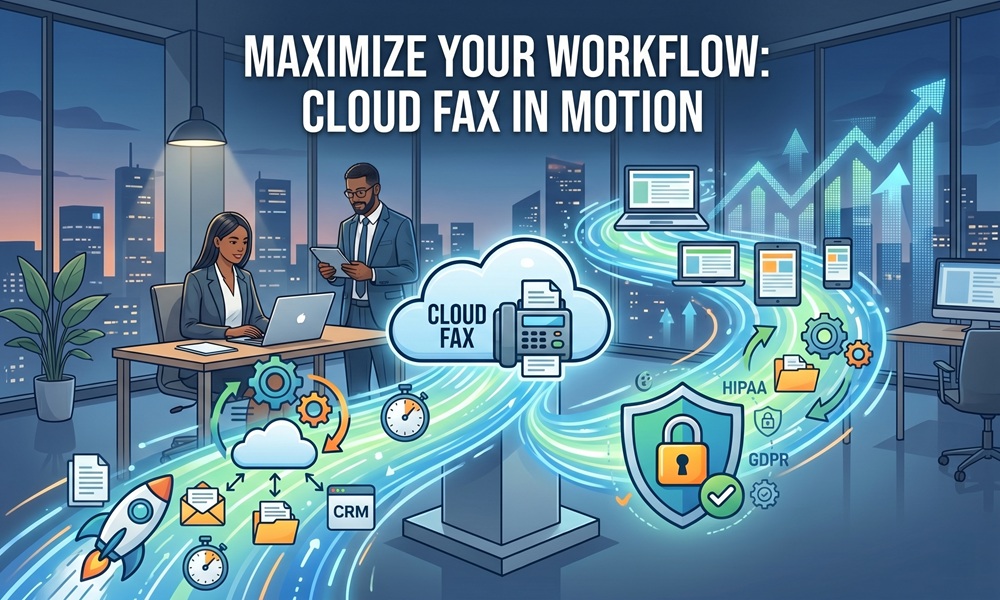
Despite living in a digitized age, businesses frequently encounter bottlenecks with traditional document transmission methods, like faxing. Research shows that companies can spend up to 55% of their time dealing with paperwork, which stifles efficiency. Cloud fax technology emerges as a solution, promising a seamless bridge between the old and the new by digitizing fax processes.
Embracing cloud fax services not only expedites document exchange but also enhances data security, archiving, and compliance. Below, we explore how this innovative approach can revitalize your business workflow and improve operational fluidity.
Exploring Cloud Fax Technology for Streamlined Business Processes
Cloud fax technology offers a major leap in streamlining business communications by eliminating the need for physical fax machines and dedicated phone lines. Companies utilizing this service can send and receive faxes directly from their computers or mobile devices, simplifying workflow and reducing manual tasks.
Cloud fax technology the immediate benefit is the reduction in hardware maintenance costs and paper usage. This is not only cost-effective but also aligns with environmentally conscious business practices. Moreover, cloud fax services ensure that documents are transmitted swiftly, leading to faster decision-making and transaction completions.
To adopt cloud fax effectively, businesses should evaluate providers on the basis of reliability, scalability, and ease of integration. Ensuring compatibility with existing systems can further enhance process efficiency without disrupting current operations.
Enhancing Document Management with Cloud Fax Solutions
Moving to a cloud fax solution transforms how organizations manage their documents. Centralized storage allows for easy access and retrieval, addressing the traditional inefficiencies associated with paper-based filing systems.
Critical documents are securely stored in compliance with industry regulations like HIPAA for healthcare or SOX for financial services. Companies no longer need to worry about physical storage space or misplaced documents, as everything is stored in the cloud with robust encryption and backup systems in place. This also significantly reduces the risks associated with disaster recovery scenarios.
Actionably, businesses can enhance document management by integrating cloud fax into their document lifecycle workflows. Tools like automatic sorting and tagging can help categorize incoming faxes, making the retrieval process for later reference or audits nearly effortless.
Cloud Fax Integration with Existing Workflows
One of the key advantages of cloud fax solutions is their ability to integrate seamlessly with existing business workflows. This interoperability ensures there is minimal disruption while shifting from traditional fax machines to a more advanced cloud-based system.
Many cloud fax services offer APIs and software integrations that work harmoniously with popular CRM and ERP systems. This level of integration allows for automated workflows, wherein received faxes can trigger specific actions or tasks within other business applications, essentially streamlining operations across various departments.
When considering integration, managers should evaluate how well the cloud fax solution can be customized to fit into their company’s specific operational ecosystem. Finding the right balance between customization and ease-of-use will yield the best results for workflow efficiency.
Measuring the Impact of Cloud Fax on Operational Productivity
Quantifying the benefits of transitioning to cloud fax technology is an important step in gauging its impact on operational productivity. Businesses often report significant time savings due to reduced manual handling of documents and faster transmission speeds.
Moreover, many organizations find that cloud fax services contribute to better resource allocation. For example, staff can be redeployed from time-intensive paper processing to more value-added activities, which can result in an average productivity boost of 30-40%. Additionally, the reduction in paper waste can lead to cost savings that are easily measured and documented for financial reporting and environmental impact assessments.
For those seeking tangible metrics, consider tracking key performance indicators such as document processing times, error rates in transmission, and employee hours spent on fax-related tasks before and after implementing a cloud fax solution. This will provide a clear view of efficiency improvements and justify the investment.
Overall, cloud fax technology stands out as a pivotal tool for businesses aiming to modernize their communication processes and enhance overall workflow efficiency. By enabling secure, fast, and environmentally friendly document transmission, it alleviates many of the burdens associated with traditional fax methods. Companies leveraging this technology not only gain operational agility but also benefit from a system that evolves with their growing needs.
