

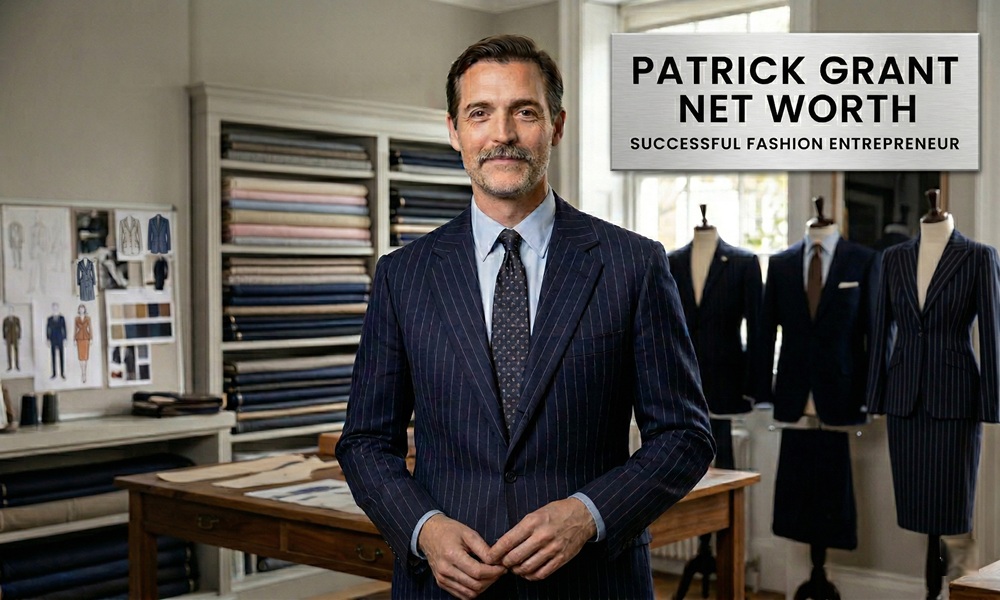
Patrick Grant is one of Britain’s most compelling fashion figures — a man who sold his house to buy a Savile Row tailoring house, saved a 160-year-old factory from closure, and built a multi-million-pound fortune while publicly campaigning for people to buy less. His story isn’t a straightforward celebrity-wealth narrative. It’s a case study in business discipline, ethical entrepreneurship, and the long game.
So just how much is Patrick Grant worth — and how did he get there?
Patrick Grant Net Worth in 2026: At a Glance
| Detail | Information |
|---|---|
| Estimated Net Worth | £10–£29 million (varies by source) |
| Primary Income Sources | Fashion businesses, television, book royalties, partnerships |
| Main Businesses | Community Clothing, Cookson & Clegg |
| Television Role | Judge, The Great British Sewing Bee (BBC One, 2013–present) |
| Notable Award | Menswear Designer of the Year, British Fashion Awards (2010) |
| Book | Less: Stop Buying So Much Rubbish (HarperCollins, 2024) |
| Academic Role | Chancellor, Queen Margaret University, Edinburgh (2025) |
| Nationality | Scottish |
| Date of Birth | 1 May 1972 |
Estimates of Patrick Grant’s net worth vary across sources. Some place it at around £3.5 million based on conservative fashion-industry earnings, while more comprehensive assessments that account for business equity, brand value, and long-term ownership put the figure closer to £29 million. The wide range reflects a fundamental truth about Grant: he reinvests aggressively, keeps personal earnings modest, and derives much of his wealth from the value of businesses he owns rather than liquid salary.
Who Is Patrick Grant? A Quick Background
Patrick James Grant FRSA was born on 1 May 1972 in Edinburgh, Scotland, in the Morningside district. His background is far from the typical fashion-world origin story. His father, James Grant, managed the pop band Marmalade before becoming an accountant; his mother, Susan, worked for the University of Edinburgh.
He attended Edinburgh Academy and then Barnard Castle School as a boarder, where he represented Scotland at rugby union at U18 and U19 level. After a gap year playing for West Hartlepool R.F.C., a shoulder injury cut short his rugby ambitions.
Grant then studied materials science at the University of Leeds (graduating in 1994) and later earned an MBA from Saïd Business School, Oxford in 2005 — his thesis explored luxury brand revitalisation, with Burberry as a case study. In between, he worked variously as a ski instructor, summer camp counsellor, nanny, landscape gardener, and marketing executive in the tech sector.
None of this looks like a path to fashion fame — and that’s exactly what makes his success so instructive.
How Patrick Grant Built His Wealth
Buying Norton & Sons (2005)
The turning point came in 2005 when Grant spotted an advertisement in the Financial Times for the sale of Norton & Sons, a historic Savile Row tailoring house. He had never seriously planned a fashion career, but the opportunity resonated with his thesis work and his fascination with craftsmanship.
He funded the purchase by selling his house, his car, and everything else he owned, supplementing this with a bank loan and money raised from friends and family. The asking price was, in his own words, “hundreds of thousands, not millions” — low enough that a motivated buyer with savings could feasibly make the move.
Over the following years, Grant restructured Norton & Sons, repositioning it as a premium heritage brand while rebuilding its client base and craft reputation. He then relaunched the dormant E. Tautz & Sons label as a ready-to-wear menswear line in 2009, winning the Menswear Designer of the Year award at the British Fashion Awards in 2010.
Saving Cookson & Clegg (2015)
In 2015, Grant received an email informing him that Cookson & Clegg — a Blackburn clothing manufacturer founded in 1860 and a key supplier to Norton & Sons — was about to shut down, putting 60 people out of work. He stepped in and purchased the factory.
The decision was not primarily financial. As Grant has said publicly: “I’d worked with these people, and I didn’t want to see them chucked on the scrapheap.” Today, Cookson & Clegg operates with a 40-strong workforce and has invested in digital production systems expected to boost productivity by 40%, partnering with the Made Smarter North West Adoption Programme.
Founding Community Clothing (2016)
Motivated by the near-collapse of Cookson & Clegg and his growing frustration with fast fashion, Grant launched Community Clothing in 2016 — a social enterprise and manufacturer’s cooperative based in Blackburn. The concept: produce high-quality clothing staples year-round at British factories, smoothing out the seasonal gaps that typically leave mills idle.
The launch was funded through a Kickstarter campaign that raised over £88,000 from more than 1,000 backers across 25 towns and 10 countries. Community Clothing has since partnered with major retailers including John Lewis, Selfridges, and eBay, and now works with a network of over 20 factories across England, Scotland, and Wales.
Patrick Grant’s Income Streams
Patrick Grant’s wealth is not derived from a single source. It flows from a portfolio of interconnected ventures, each reinforcing the others.
Business Ownership and Equity
The most significant component of Grant’s net worth is his ownership stake in his businesses. Community Clothing, Cookson & Clegg, and (previously) Norton & Sons represent accumulated brand equity built over two decades. This kind of wealth doesn’t appear in a weekly salary — it lives in the long-term value of the enterprises.
Television Appearances
Since 2013, Grant has been a judge on The Great British Sewing Bee, one of the BBC’s most beloved craft programmes. The show moved from BBC Two to BBC One in 2020, significantly expanding its audience. While Grant has been publicly guarded about his BBC fee, judges and presenters on comparable long-running BBC programmes typically earn between £50,000 and £150,000 per series. His consistent presence across more than a decade means television has contributed meaningfully to his overall income.
Books and Publishing
In May 2024, Grant published Less: Stop Buying So Much Rubbish: How Having Fewer, Better Things Can Make Us Happier (HarperCollins). The book became a talking point in sustainable fashion and personal finance circles, praised for its accessible tone and practical philosophy. He also edited Original Man: The Tautz Compendium of Less Ordinary Gentlemen (Gestalten, 2014) and authored The Savile Row Suit: The Art of Hand Tailoring on Savile Row (Gestalten, 2024). Book royalties add a growing revenue stream aligned with his public profile.
Brand Partnerships and Speaking
Grant’s standing as a sustainable fashion authority makes him a sought-after voice for brand partnerships, keynote speeches, and academic engagements. His 2025 appointment as Chancellor of Queen Margaret University in Edinburgh is unpaid but reflects the cachet that translates into commercial speaking opportunities and consulting value.
Income Sources: Estimated Breakdown
| Income Source | Estimated Contribution |
|---|---|
| Business equity (Community Clothing, Cookson & Clegg) | Largest share (long-term value) |
| Television (Great British Sewing Bee) | Significant recurring income |
| Book royalties (Less, Savile Row Suit) | Moderate and growing |
| Brand partnerships and consulting | Supplementary |
| Public speaking and academic roles | Supplementary |
Key Career Milestones
A Timeline of Patrick Grant’s Rise
- 1994 — Graduates in materials science, University of Leeds
- 2000–2004 — Works in the tech sector (Bookham Technology, BICC, Corning)
- 2005 — Purchases Norton & Sons, Savile Row; completes MBA at Oxford
- 2009 — Relaunches E. Tautz & Sons as ready-to-wear label
- 2010 — Wins Menswear Designer of the Year at the British Fashion Awards
- 2013 — Joins The Great British Sewing Bee as a judge
- 2013 — Named Honorary Professor, Glasgow Caledonian University
- 2015 — Purchases Cookson & Clegg, saving it from closure
- 2016 — Founds Community Clothing via Kickstarter
- 2020 — Sewing Bee moves to BBC One; relocates to North Yorkshire
- 2024 — Publishes Less (HarperCollins) and The Savile Row Suit (Gestalten)
- 2025 — Appointed Chancellor of Queen Margaret University, Edinburgh
- 2025 — Speaks at Edinburgh Science Festival on fast fashion and climate
What Makes Patrick Grant’s Wealth Model Unusual
Most fashion wealth is built on volume — more products, more seasons, more markets. Grant has consistently done the opposite. He sells fewer things at higher quality, campaigns against overconsumption even as a retailer, and pays himself modestly while reinvesting in his companies.
As he told one interviewer: “Money is not a huge motivator for me. I could have worked for a hedge fund and earned a lot of money.”
This philosophy shapes his businesses structurally. By avoiding overproduction and trend-chasing, his companies face less volatility and maintain stronger brand equity over time. Community Clothing’s model — producing basics year-round rather than in seasonal bursts — stabilises cash flow for both the brand and its partner factories.
The result is a form of wealth that is heavily tied to ownership and long-term business value rather than salary or celebrity endorsement income. It’s a slower accumulation — but a more resilient one.
Personal Life and Lifestyle
Grant lives in North Yorkshire, near the village of Austwick, having relocated from London in March 2020 to be closer to his Blackburn factory. He describes his home as being on the boundary of the Yorkshire Dales National Park and the Forest of Bowland — “glorious pastureland,” in his own words.
His lifestyle reflects his values. He forages for food, cycles regularly through local landscapes, and famously furnished his office with items sourced from Freecycle and skips. He is private about his romantic life, though he revealed in a 2023 interview with The Times that he was in a relationship with a London dentist he met at a dinner party. He has no children. His sister, Victoria Grant, works within his businesses.
He has also been open about personal struggles — including anxiety and depression — and has used his public platform to reduce stigma around mental health.
Awards and Recognition
| Award / Recognition | Year |
|---|---|
| Menswear Designer of the Year, British Fashion Awards | 2010 |
| Honorary Professor, Glasgow Caledonian University | 2013 |
| Fellow of the Royal Society of Arts (FRSA) | Ongoing |
| Chancellor, Queen Margaret University, Edinburgh | 2025 |
Patrick Grant and Sustainable Fashion: The Bigger Picture
Grant has become one of the UK’s most credible voices on the environmental cost of fast fashion. He argues that 95% of clothing produced today lacks meaningful reuse value, and that the fashion industry’s seasonal model drives both waste and economic instability for manufacturers.
Through Community Clothing, his book Less, and platforms like the Edinburgh Science Festival, he advocates for a simple but radical idea: buy less, buy better, and make it last.
This position has made him distinctive in an industry crowded with brands that simultaneously claim sustainability credentials while selling increasing volumes. Grant’s approach is to build businesses whose entire structural model — year-round production, quality materials, domestic manufacturing — embodies the values he preaches.
Frequently Asked Questions
What is Patrick Grant’s net worth in 2026?
Estimates range between £3.5 million and £29 million depending on methodology. The higher figure accounts for equity in his businesses, brand value, and long-term assets. Conservative salary-based estimates produce lower numbers. A reasonable mid-range consensus places his net worth in the region of £10–£15 million.
How did Patrick Grant make his money?
Primarily through owning and running fashion businesses — Norton & Sons, E. Tautz, Cookson & Clegg, and Community Clothing — along with over a decade of television work on The Great British Sewing Bee and, more recently, book publishing.
Is Patrick Grant married?
No. He is reportedly in a relationship but has kept his personal life largely private.
What is Community Clothing?
A social enterprise and clothing cooperative founded by Grant in 2016, based in Blackburn. It produces affordable, durable clothing staples manufactured at British factories with the goal of sustaining UK textile jobs and reducing clothing waste.
What book did Patrick Grant write?
Less: Stop Buying So Much Rubbish: How Having Fewer, Better Things Can Make Us Happier (HarperCollins, 2024). He also authored The Savile Row Suit (Gestalten, 2024).
Final Thoughts
Patrick Grant’s net worth is, in many ways, a secondary part of his story. What’s remarkable is not the figure itself but the model behind it — a deliberate, values-driven approach to business that has produced both commercial success and genuine social impact. He bought a failing Savile Row tailor with everything he had, saved a 160-year-old factory on a Sunday night impulse, and turned both into a platform for changing how Britain thinks about clothes.
Whether his net worth is £10 million or £29 million, the architecture of how he built it is far more instructive than the number.
